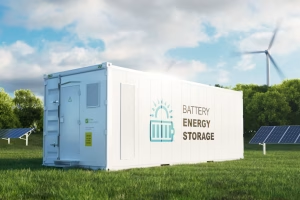
Battery Storage (electrochemical)
📘 Technology description
Battery storage systems store electrical energy in chemical form and then release it as electricity. The most commonly used technologies include:
– Lithium-ion batteries (Li-ion): The dominant solution today, characterized by high efficiency (90–95%) and energy density.
– Lithium iron phosphate batteries (LFP): More durable and safer than classic Li-ion.
– Sodium-ion batteries (Na-ion): A developing alternative for lower cost and reduced dependence on lithium.
– Flow batteries: Use liquid electrolytes (e.g., vanadium), allowing independent scaling of capacity and power.
✅ Advantages
– High energy efficiency (up to 95%).
– Fast response time – ideal for grid balancing and voltage stabilization.
– Scalable – from household systems to large-scale installations.
– Declining costs thanks to battery industry growth.
– Can operate in off-grid mode.
⚠️ Limitations
– Limited lifetime (3–15 years depending on chemistry and cycles).
– Capacity degradation over time.
– Fire risk (especially in lithium-ion technologies without proper safety systems).
– High production energy demand and dependence on critical materials (lithium, cobalt, nickel).
– Require cooling and battery management systems (BMS).
🏭 Applications
– Grid stabilization (BESS) – balancing renewable power generation.
– Industry – reducing energy costs (peak shaving).
– Municipalities and energy communities – storing PV or wind energy.
– Commercial and residential buildings – increasing self-consumption of solar energy.