
Two Ways to Bottle the Wind
Author: Maciej Witkowski
Turning surplus electricity into hydrogen, and back again, and the surprisingly large difference it makes which machine you choose
The world has, in a sense, already solved its renewable energy problem. There is enough sunlight striking the planet to power human civilisation more than a hundred times over, and wind alone could comfortably meet global demand. The trouble is timing. The sun sets, the wind drops, and a solar panel cannot store a sunny afternoon for use on a dark evening, let alone save summer for winter. This mismatch between when clean energy is generated and when it is needed is the single largest obstacle standing between us and a low-carbon grid.
We do have storage. Pumped hydro, compressed air and batteries have been balancing electricity grids for decades. But all of them share the same limitation: they think in hours and days, not months and years. A lithium-ion battery is superb at smoothing out an afternoon and hopeless at carrying a windy October into a still January. None of them can do much, either, for the long-haul transport sector, the trucks, ships and aircraft that, alongside heavy industry, are responsible for roughly a quarter of global CO2 emissions. To balance the longer rhythms of wind and weather, and to reach the parts of the economy that wires cannot, we need a genuinely seasonal store of clean energy.
Enter hydrogen
This is where hydrogen comes in. A power-to-gas system uses surplus electricity, the kind a wind farm produces in abundance on a gusty night when most of the country is asleep, to split water through electrolysis. The result is hydrogen: a gas that can be stored for months, shipped, burned, or turned into carbon-neutral fuels for the very transport sectors that batteries struggle to reach. If the electricity doing the splitting is itself renewable, the hydrogen is effectively decoupled from fossil fuels altogether.
Hydrogen is not a perfect fuel. It is awkward to store, kept liquid only at -253°C, or otherwise squeezed to hundreds of times atmospheric pressure, and a hydrogen tank holding the same energy as a diesel one would weigh around six times more and take up eight times the space. But it remains the only practical option for the week-to-month storage that smoothing out wind power demands, and that single fact keeps it at the centre of energy research.
The technology that does this work has been getting steadily better. Solid oxide electrolysis cells (SOECs), in particular, run hot, between 400 and 800°C, compared with the 60–160°C of more conventional cells, and that heat makes the chemistry markedly more efficient. Their performance has improved roughly two-and-a-half-fold over the past fifteen years, and they are built from materials the Earth has in abundance. The contrast with batteries is stark: storing a day’s worth of a terawatt of power in lithium-ion cells would consume something like 160 years of current global lithium production.
The reversible twist
What if the machine could run both ways?
A reversible power-to-gas (rPtG) system does not just make hydrogen when electricity is cheap. It can also burn that hydrogen to generate electricity again when prices spike. Hydrogen stops being a final product and becomes, in effect, a battery, one that can hold its charge for a season rather than a day.
There are two ways to build such a system
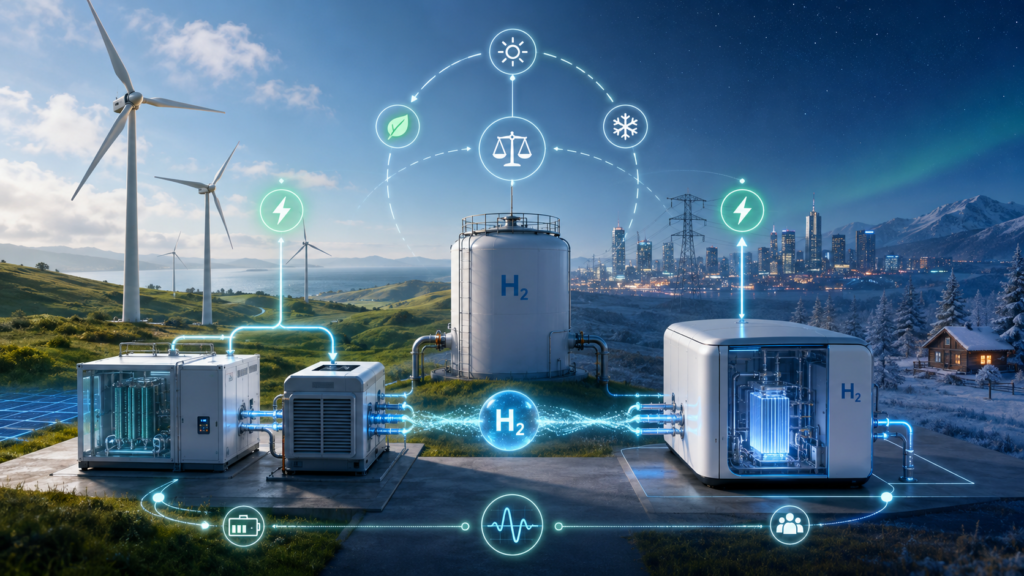
The modular system uses two separate machines: a one-directional electrolyser to make hydrogen, and a separate fuel cell or gas turbine to turn it back into power. The integrated system uses a single piece of equipment, a reversible solid oxide cell, that simply runs in whichever direction the moment calls for. The modular design has an obvious drawback: you buy two machines, and while one works the other usually sits idle. The integrated design avoids that redundancy, but has long been dismissed as too immature to take seriously.
We put the two head to head, and added one more idea. Both systems were paired with a wind turbine. By feeding the turbine’s output straight into the rPtG machine, the system can sidestep the price markup of the open electricity market entirely. It pays the market price only when it has to.
Watching the machine think
To test the rivals, we ran them against years of real, hour-by-hour electricity prices from the German market. For every single hour, the model worked out what a profit-maximising operator would do: sell the wind power, sit idle, make hydrogen from cheap power, or, in the most extreme case, buy hydrogen and burn it because electricity had become so valuable. This last option, the case where prices climb high enough to justify running the whole system in reverse, is the novel contribution: a fifth operating “phase” added to a framework that previously had only four.
The headline finding is decisive. The integrated system wins – almost everywhere.
Across every dataset tested, the single reversible solid oxide cell delivered a substantially higher lifetime value than the two-machine modular alternative. For the most representative price data, the integrated system’s net present value came out around €10.3 million against the modular system’s €6.5 million. The gap is not a quirk of one particular year; it held up when we varied the system’s size, its efficiency, the price of hydrogen, the plant’s lifespan and its purchase cost. The integrated machine has three quiet advantages, it converts electricity to hydrogen more efficiently, it lasts longer in hydrogen-making mode, and it is cheaper to buy. Together these compound into a lead the modular system simply cannot close.
The money is in the hydrogen
One result stands out as genuinely counter-intuitive. The reversible feature, the ability to burn hydrogen for electricity, turns out to be almost a footnote. Hydrogen production is where nearly all the value sits, and it dwarfs anything earned from generating power.
The evidence is striking. Compare the two record-breaking years of 2021–2022, when German electricity prices tripled and even hit highs above €0.60 per kilowatt-hour, with the calmer years of 2019–2020. You might expect the expensive years to be more profitable, after all, electricity is what you sell. In fact both systems earned less in the high-price years. Expensive electricity is wonderful to sell but punishing to buy as feedstock, and the squeeze on hydrogen-making more than cancels out the windfall from occasional power generation.
In the moderate years, the systems essentially never ran in reverse at all. Not a single hour was expensive enough to make burning hydrogen worthwhile — the price would have to reach roughly €0.60 per kilowatt-hour for the integrated system, or €0.54 for the modular one, before reversal pays. In an ordinary year, then, the celebrated “reversibility” of a reversible power-to-gas system would simply be an unused, paid-for capability.
This carries a neat corollary: reversibility becomes more valuable, not less, when hydrogen is cheap. When hydrogen is worth little, the balance tips more often toward burning it for electricity instead.
When does the underdog win?
There is exactly one scenario in which the modular system pulls ahead. Its electricity-generating module is built to last longer than the integrated cell, so when power generation becomes the main event, that longevity finally pays off. But for it to overtake the integrated rival, electricity prices have to rise roughly tenfold.
That is not impossible. Prices climbed sevenfold between 2019 and 2022, and today’s geopolitical climate keeps upward pressure on energy markets. But a tenfold, sustained surge, without hydrogen prices rising in step, is a specific bet, and it is hard to say how likely such a future is.
One more practical note for anyone tempted to obsess over the sticker price: it barely matters. Varying the cost of the equipment by as much as 60% in either direction moved the final result only marginally. What truly drives the economics is how long the system lasts and how efficiently it converts electricity into hydrogen.
The verdict
We reach a confident conclusion. Reversible solid oxide cell technology is no longer a laboratory curiosity confined to pilot projects, it is ready for wider adoption, and on the strength of these numbers it is already the more profitable choice. The remaining obstacles are not really technical; they are economic and legislative, the familiar friction of long payback periods, heavy upfront costs and the policy decisions needed to get investment flowing.
The longer-term promise is larger still. A reversible power-to-gas system can act as a bridge between the electricity grid, the gas network and the fuels that move freight across oceans and continents. It can absorb a surplus that would otherwise be wasted and release it, months later, where it is needed. There is even a tantalising next step on the horizon: ammonia, cheaper than hydrogen, carbon-neutral, and a perfectly adequate fuel for these same cells.
The wind, it turns out, can be bottled. The question we answer is which bottle to buy, and, for now, the simpler one wins.